By Laksamana Sukardi
The recently concluded tariff agreement between Indonesia and the United States has been welcomed in some quarters as a breakthrough. In reality, it is something more modest — a tactical adjustment within a more protectionist global trade environment.
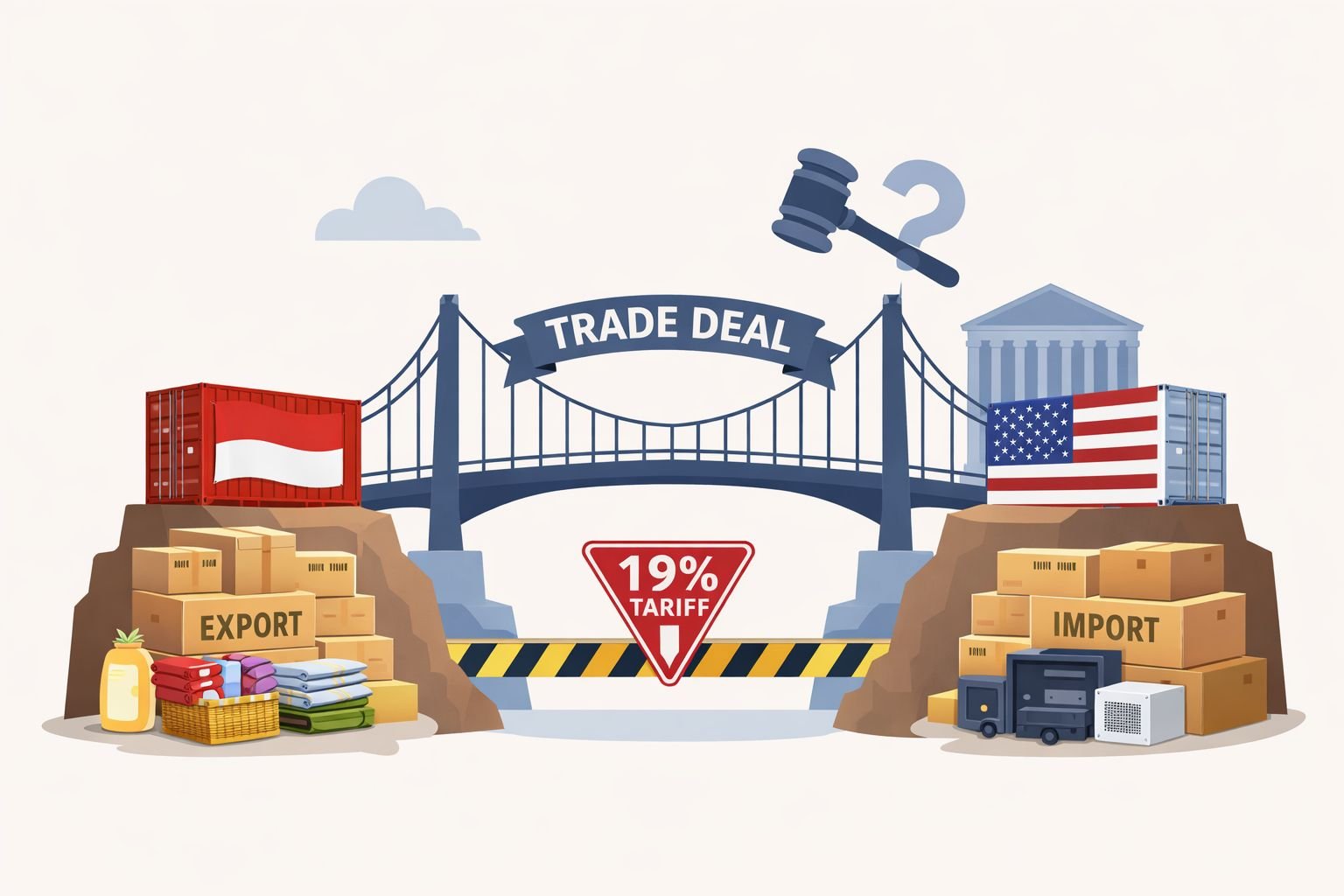
Indonesia has secured zero-tariff access for certain textile and garment exports under a TRQ (Tariff-Rate Quota) mechanism, while most exports remain subject to a reciprocal tariff of roughly 19 percent. A TRQ allows a limited quantity of goods to enter at zero or reduced tariffs, with higher tariffs applying once that quota is exceeded.
The immediate question is simple: Is this good for Indonesia?
The honest answer is: Yes — but only partially.
The Sectoral Upside
Indonesia’s textile and garment industry stands to benefit most. Zero tariffs within quota limits lower landed costs in the U.S. market and provide breathing room for labor-intensive exporters competing with producers from Vietnam, Malaysia, and Thailand.
Because the United States has applied similar reciprocal tariff frameworks to ASEAN competitors, Indonesia is not uniquely disadvantaged. That parity matters. In a world of rising trade barriers, neutrality is sometimes the best achievable outcome.
Selected agricultural lines — including palm oil derivatives — also gain some market space. For export sectors under pressure at home, these openings are economically meaningful.
Moreover, the agreement stabilizes bilateral trade relations with the United States, Indonesia’s key export destination and a critical source of investment, technology, and financial influence.
The Structural Limits
But the celebration must be restrained.
First, the 19 percent reciprocal tariff remains broadly in place. This is not free trade; it is managed trade. The deal offers targeted relief, not structural liberalization.
Second, zero tariffs are contingent upon compliance with RoO (Rules of Origin) — requirements determining how much local content a product must contain to qualify. If Indonesian garments rely heavily on imported yarn or fabric, exporters may fail to qualify. Without upstream industrial strengthening, tariff preferences may remain underutilized.
Third, Indonesia remains exposed to U.S. trade remedies:
• AD (Anti-Dumping duties) — imposed when goods are deemed sold below fair value.
• CVD (Countervailing Duties) — imposed to offset foreign subsidies.
Sectors such as solar manufacturing in Southeast Asia have recently faced aggressive U.S. trade enforcement. Indonesia is not immune.
Fourth, reciprocal arrangements often carry implicit regulatory expectations — from digital governance to procurement transparency. These may gradually narrow domestic policy flexibility.
This is therefore not a clean win, but a calibrated compromise.
The Supreme Court Variable
An additional uncertainty now enters the equation: the recent decision of the Supreme Court of the United States concerning the scope of executive trade authority.
While the full implications are still unfolding, the ruling potentially affects how the U.S. executive branch can impose or sustain certain tariff measures without explicit congressional authorization. If the Court narrows executive discretion, several consequences may follow:
`1. Greater Policy Volatility
If future tariff actions require stronger congressional backing, trade measures could become more politicized and less predictable. Indonesia may face shifting rules depending on domestic U.S. political cycles.
2. Legal Challenges to Existing Tariffs
If litigants challenge tariff frameworks derived from broad executive authority, some measures — including reciprocal tariffs — could face modification or reinterpretation.
If litigants challenge tariff frameworks derived from broad executive authority, some measures — including reciprocal tariffs — could face modification or reinterpretation.
3. Negotiation Leverage Shift
Should the Court constrain executive flexibility, trade negotiations may move more decisively into legislative arenas. This would slow deal-making but potentially increase durability once agreements are enacted.
For Indonesia, the key risk is uncertainty. Investors value stability. If U.S. tariff authority becomes legally contested terrain, exporters may hesitate to expand capacity until clarity returns.
What Indonesia Must Do Now
This agreement will only be as beneficial as Indonesia’s domestic preparation.
1. Maximize TRQ utilization by ensuring exporters fully understand origin rules and certification procedures.
2. Strengthen upstream textile inputs (yarn, fabric) to meet local content thresholds.
3. Build trade litigation capacity to respond swiftly to AD/CVD investigations.
4. Diversify export markets to reduce overdependence on a single major partner.
The lesson is clear: trade agreements create opportunities, not guarantees.
A Realistic Verdict
The Indonesia–U.S. tariff deal is a pragmatic adjustment in an era of managed globalization. It preserves competitiveness relative to ASEAN peers and provides tactical relief to key sectors. But it does not fundamentally transform Indonesia’s trade structure.
The added uncertainty from the recent U.S. Supreme Court ruling reminds us that global trade today is shaped as much by domestic legal battles as by diplomacy.
Indonesia should therefore treat this agreement not as a destination, but as a bridge — one that must be crossed with strategic discipline, industrial upgrading, and legal preparedness.
In trade, as in politics, advantage belongs not to those who celebrate first, but to those who prepare longest.
Jakarta, February 22, 2026.