
By Laksamana Sukardi
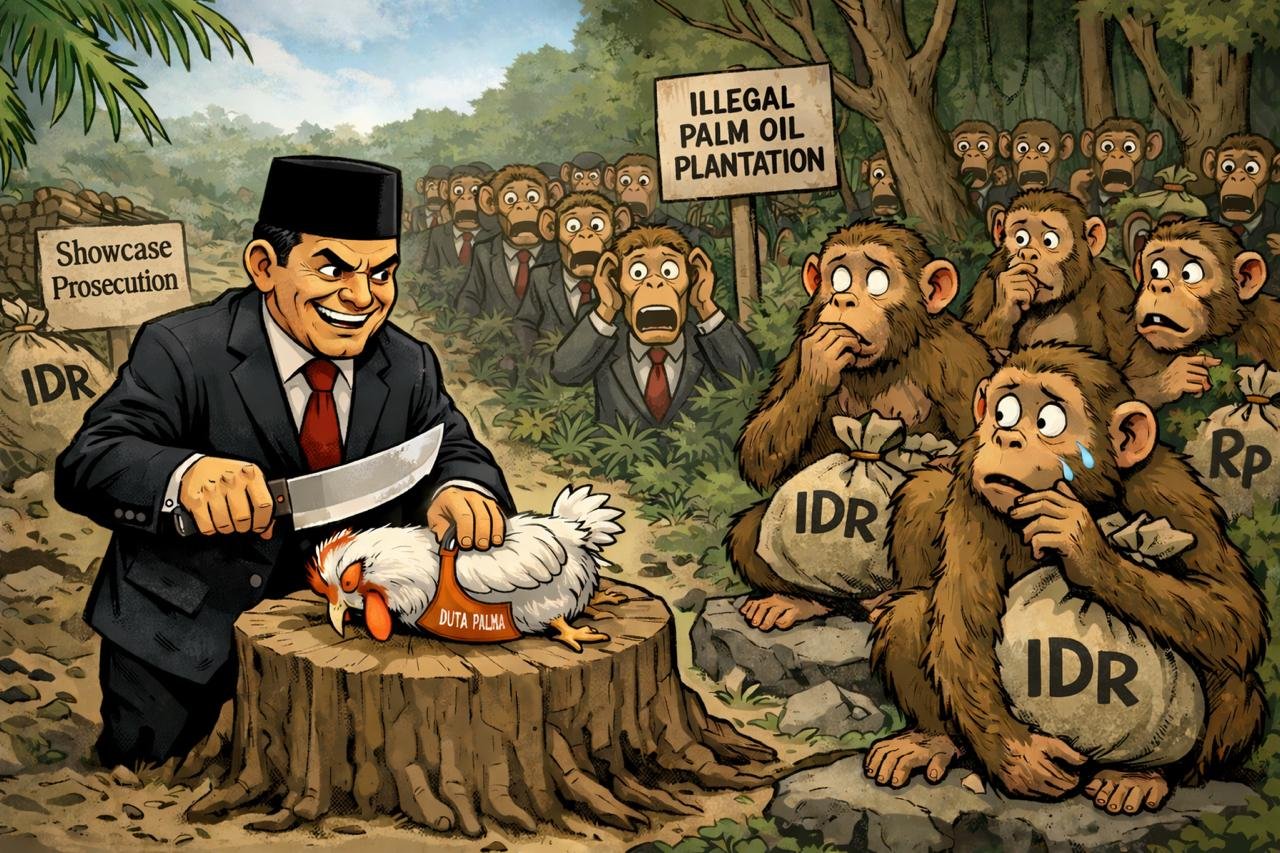
The case of illegal palm oil plantations resulting from unlawful forest conversion has been presented as proof that the law is finally being enforced against palm oil tycoons—most notably Surya Darmadi, the owner of the Duta Palma Group, who was sentenced by the court to 15 years in prison and fined IDR 2.2 trillion.
When Surya Darmadi was convicted, the state appeared resolute in addressing violations of forest conversion for palm oil plantations. The environmental damage caused by Duta Palma—amounting to IDR 39.7 trillion—was calculated as a grave loss to the state. The case was even promoted as a “salvo shot,” marking the beginning of an anti-corruption campaign against the manipulation of forest conversion by palm oil magnates.
It soon became clear, however, that Duta Palma was not alone. Many other palm oil tycoons had committed similar violations. A 2022 audit report by the Supreme Audit Agency identified three million hectares of illegal palm oil plantations within forest areas lacking proper conversion permits.
Meanwhile, the Forest Area Enforcement Task Force reported the seizure of 3.3 million hectares of illegal palm oil plantations (Kompas.com, 26 September 2025). More recent reports place the figure at four million hectares. Approximately three million hectares of these illegal plantations have since been transferred to PT Agrinas Palma Nusantara, a state-owned enterprise.
Compared with the nationwide total of four million hectares of illegal plantations, the 222,000 hectares of Duta Palma land confiscated by the state (CNBC Indonesia 10/03/2025) appear relatively modest. Yet the owner of Duta Palma was sentenced to 15 years in prison and ordered to pay a fine of IDR 2.2 trillion. By contrast, those responsible for the illegal conversion of four million hectares of forest land were not brought before criminal courts; their cases were resolved through an “administrative adjustment” scheme, requiring them only to pay fines totaling IDR 6.6 trillion.
The handling of these cases has been almost entirely opaque. The identities of the violators and the criteria applied have never been disclosed. Why were these cases not processed through transparent judicial proceedings, as in the Duta Palma case—especially when the scale of the offenses was far larger and truly colossal? By comparison, the total land area of Singapore is only about 74,000 hectares.
When law enforcement operates without transparency, public suspicion becomes inevitable. In such a system, the law is no longer perceived as a mechanism of justice, but as an instrument of bargaining. Unclear rules and inconsistent enforcement create a shadowy space prone to abuse, including suspicions that legal threats may morph into political ransom: pay to survive, comply to be protected.
No explicit evidence is required to arrive at such suspicions. It is enough to observe what has become an open secret: violations are massive and widely known; enforcement is selective and never openly explained. Only the public display of stacks of cash amounting to IDR 6.6 trillion is offered as mute testimony—without clarity as to their origin or who paid them. It is as though the public were watching a magic show, an “abracadabra” performance.
At this point, the Duta Palma case begins to resemble the proverb “slaughtering a chicken in front of monkeys.” The act is not merely to punish the chicken, but to ensure that the monkeys watch, grow fearful, and—most importantly—become cooperative. The message is ambiguous yet effective: see what can happen. And yet it also carries an implicit warning: your fate may differ, depending on your attitude.
If such extra-judicial processes persist, fear becomes an instrument of policy and uncertainty the currency of power. It is in this space that negotiation thrives—not in open courtrooms, but behind closed doors shrouded in mystery.
The problem is that law enforced as intimidation does not build legitimate compliance; it produces only transactional obedience. Once the pressure eases, violations again become rational, and illegal forest conversion continues unabated.
Worse still, practices of this kind erode the state’s own legitimacy. The public sees no justice; businesses see no legal certainty, only arbitrary power. Law enforcement officers on the ground absorb a dangerous lesson: the law is not a standard, but an option.
If the state truly intends to restore ecological stability in the wake of illegal forest conversion, the answer lies in clear rules, non-selective law enforcement, and transparent judicial processes—without exceptions and without covert negotiation.
Absent these, every major case will be remembered merely as a castration of the law: proof that in this republic, legality is often not about right or wrong, but about who is chosen—and who failed to negotiate properly. And as long as the law is used to intimidate rather than to govern, justice will remain a mirage, while flash floods become a recurring burden on the national budget and a source of suffering for the people.
Jakarta, 25 December 2025