By Laksamana Sukardi
For years, the warning signs were unmistakable. Satellite images showed forests across Indonesia receding at a staggering rate. Hillsides were carved open for plantations and mines. Rivers were narrowed to make way for speculative development. Watersheds — the country’s quiet, natural guardians — were steadily stripped of their ability to hold back the rain.
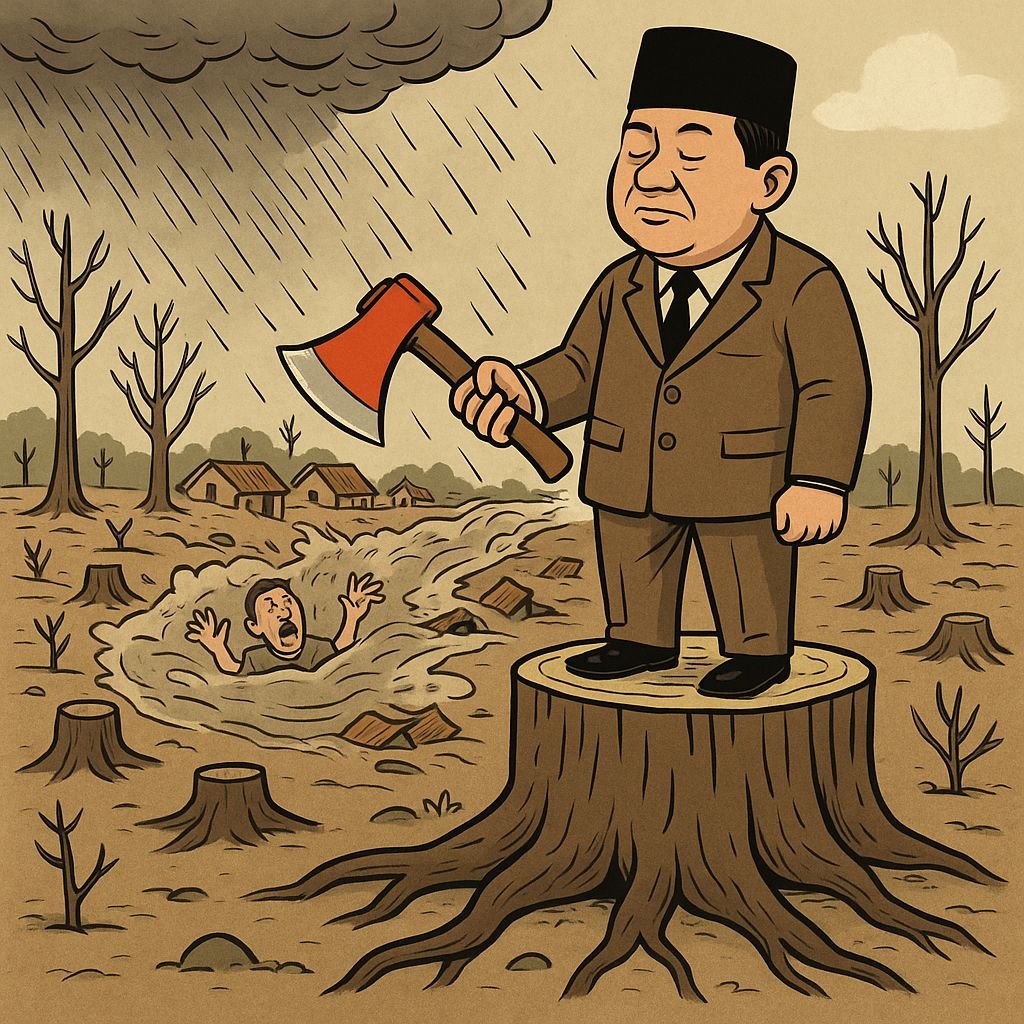
When the recent catastrophe unfolded in Sumatra, with flash floods and landslides tearing through communities, many pointed to extreme rainfall. But the true cause runs deeper. The disaster was not simply the result of a storm. It was the inevitable consequence of political decisions made long before the first drop of rain fell.
Indonesia is now confronting the cumulative effects of what might be called “serakah-nomics” — an extractive, short-term economic logic that places private gain above public safety, and silence above stewardship.
When governance erodes, nature fills the vacuum
Major landslides do not occur spontaneously.
Flash floods do not materialize overnight.
They are built slowly, through choices made in government offices and legislative chambers:
• Permits issued with minimal scrutiny.
• Environmental safeguards weakened or ignored.
• Impact assessments treated as box-checking exercises.
• Regulatory agencies sidelined by political pressure.
• Policies shaped by the interests of a well-connected few.
These decisions have reshaped Indonesia’s physical landscape. Hills have been destabilized not because the public demanded it, but because entrenched business interests benefited. Rivers narrowed not out of incompetence, but because political leaders looked the other way.
Greed today is less often expressed through envelopes of cash than through what officials choose not to do — the oversight not exercised, the warnings not heeded, the silence that allows destructive practices to continue.
A high price for a false sense of growth
For years, political leaders justified the clearing of forests and the expansion of extractive industries as necessary for economic growth. But the bill for this growth has now arrived, and it is steep.
Bridges and roads have been destroyed.
Electricity networks severed.
Thousands of homes swept away.
Regional economies thrown into disarray.
As of Dec. 3, 2025, the death toll in Sumatra has reached 753, and 3.3 million people have been affected across 50 districts. These are not abstract numbers. They represent families uprooted, livelihoods erased, and communities forced to start again with little more than grief and mud-soaked debris.
Meanwhile, the financial benefits from extractive industries have flowed largely to a narrow segment of Indonesian elites — and abroad. A significant portion of the foreign-exchange earnings from these sectors ends up resting in banks in Singapore, far from the communities that now face the consequences.
Nature does not respond to political convenience
Nature has no interest in bureaucratic timelines or political cycles.
It responds only to what it encounters on the ground.
When forests are razed, the rains accelerate downhill.
When science is ignored, slopes fail.
When governance falters, the consequences accumulate.
Indonesia can replant forests, widen rivers and strengthen eroding hillsides. But no environmental fix will endure without political reform. Restoring the land requires confronting the political architecture that allowed it to be degraded in the first place.
Two steps are essential:
1. Independent environmental audits insulated from political interference.
2. A moratorium on development permits in ecologically sensitive areas.
Such reforms demand political courage — a scarce resource in any democracy, and especially where economic interests are deeply entrenched.
Environmental stewardship is now national security
Indonesia cannot change the intensity of global climate events. But it can determine how prepared the country is to withstand them.
Increasingly, environmental governance is not merely a policy area; it is a form of national defense. Hydrometeorological disasters already account for more than 90 percent of Indonesia’s annual emergencies, and climate volatility will only intensify them.
Defense Minister Sjafrie Sjamsoeddin’s warning — “Do not allow a state within the state” — resonates strongly. The Sumatra disaster illustrates what happens when parallel systems of power, defined by greed and neglect, undermine the formal state’s ability to protect its citizens.
Environmental policy must therefore be treated as a pillar of national resilience, not a bureaucratic formality. It safeguards lives, stabilizes public finances and underpins long-term economic competitiveness.
Not every Indonesian official is complicit in ecological decline. But too many have chosen to remain silent.
And in environmental governance,
silence is not neutrality. It is participation.
South Jakarta
Dec. 5, 2025