Indonesia vs Singapore: Two Different Paths
By Laksamana Sukardi
—————————————-
A Tale of Two Economies
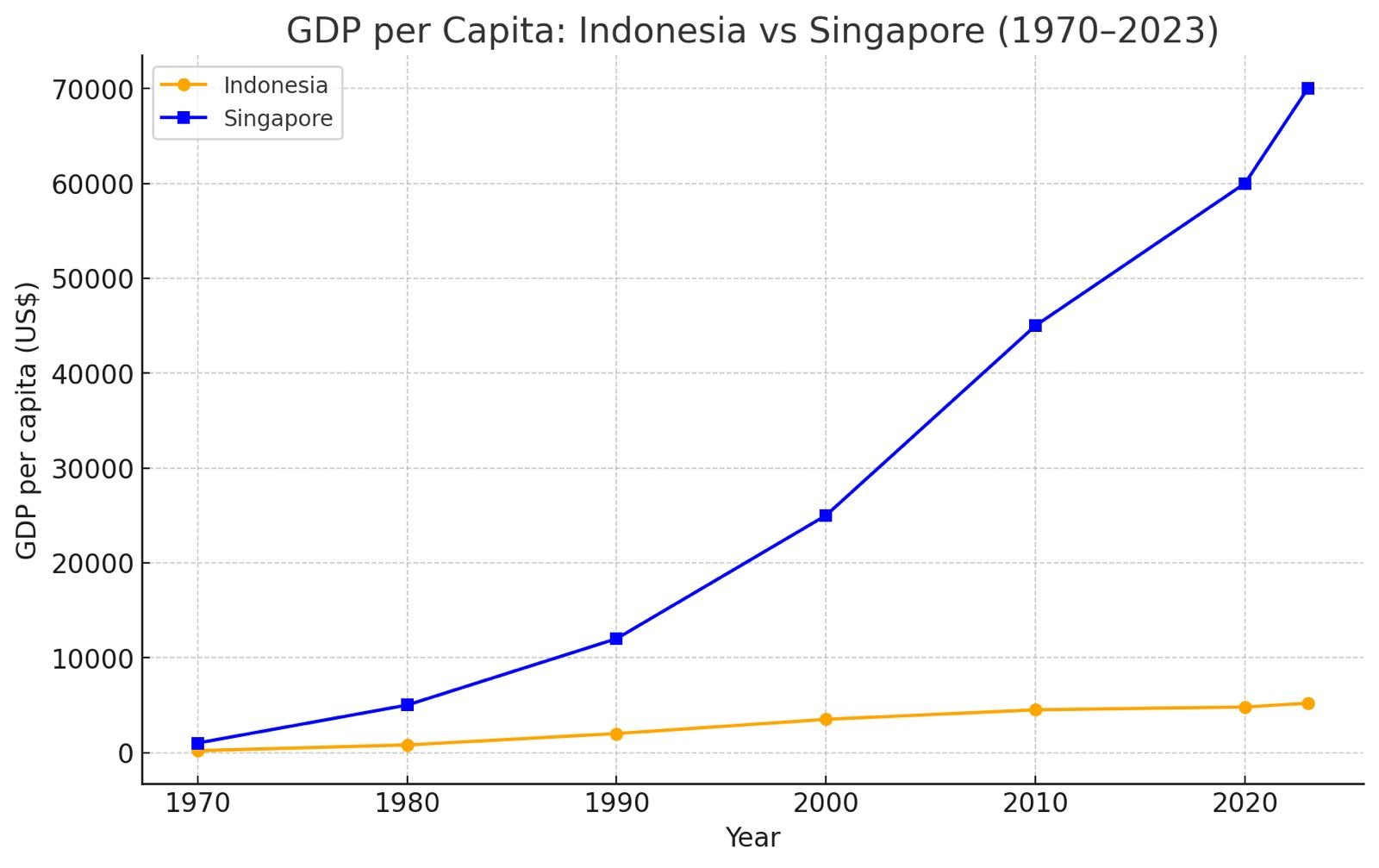
In 2023, Singapore’s per capita income reached US$74,000, while Indonesia’s remained at US$5,000—still stuck in the middle-income trap.
This is remarkable considering that, in the 1970s and 1980s, both countries were poor, with per capita incomes below US$1,000. (See Chart)
Why has resource-rich Indonesia, blessed with a large population and domestic market, been left behind by a small, resource-poor island nation?
Modern Colonization
When Cornelis de Houtman arrived in 1596, the Dutch East India Company (VOC) gradually turned the Indonesian archipelago into a colony, extracting its wealth by force.
Today, colonization no longer requires armies or occupation.
Thanks to information technology, algorithms, data analytics, and artificial intelligence, nations and corporations can now extract wealth without physical control.
As Thomas L. Friedman noted in The World Is Flat (2005), globalization has created a new kind of power—“modern colonization.”
Global tech giants like Microsoft, Apple, Google, Meta, and YouTube now dominate our daily lives—education, business, communication, even politics—earning trillions from the world’s economic activity.
They are today’s VOCs, extracting value not through cannons but through code.
Singapore: The Regional Extractor
Within Southeast Asia, Singapore has mastered this modern art of extraction.
Armed with world-class infrastructure, legal certainty, professional management, and technological sophistication, it has built a powerful hub that captures value from its neighbors—especially Indonesia.
Aviation: Sky-High Profits
Singapore Airlines (SIA) earns about US$15.1 billion annually—nearly five times Garuda Indonesia’s US$3.4 billion—and flies to 128 destinations in 36 countries.
Every year, over five million Indonesians travel abroad via SIA, making their spending a source of Singapore’s profit.
Changi Airport handled 67.7 million passengers in 2024, more than ten times Singapore’s population.
The busiest routes? Singapore–Jakarta and Singapore–Denpasar.
Meanwhile, Garuda remains burdened by debt, unable to capture value from its own home market.
Healthcare: Exporting Trust
Singapore’s hospitals generate US$6.77 billion a year from inpatient care, treating 646,000 foreign patients in 2024—roughly 20–30% of total patients.
Many are Indonesians seeking reliable treatment and professional service unavailable at home.
Trade and Finance: The Invisible Drain
Singapore’s trade volume reached US$900 billion in 2023, powered by PSA International, one of the world’s busiest ports.
Much of that trade originates from Indonesia—exported cheaply, repackaged and re-exported at higher prices.
Singapore’s tax-free transshipment policy has long encouraged under-invoicing: Indonesian exporters sell goods below market value to Singapore intermediaries, which then resell them abroad at a markup.
The result is massive profit leakage and lost tax revenue for Indonesia.
According to NEXT Indonesia Research, between 2014 and 2023 Indonesia lost an estimated US$401.6 billion in export value and Rp6,539 trillion in potential tax revenue—about twice our national foreign debt.
Those missing funds could have cleared our debt and financed growth at home.
VCC vs Danantara: Two Financial Realities
Singapore’s Variable Capital Company (VCC) framework, launched in 2020, offers flexible, confidential fund structures rivaling global tax havens.
In just four years, it has attracted US$6 trillion in assets—ten times Singapore’s GDP.
In addition to the VCC framework, Singapore has two fund management institutions — Temasek and GIC — with total assets under management (AUM) exceeding US$1 trillion.
Indonesia’s Danantara Fund, by contrast, claims US$900 billion in assets under management, but much of that is merely state-owned enterprise (SOE) assets reclassified through accounting maneuvers.
True equity value likely amounts to only US$270 billion.
The Lesson
Singapore’s success is not accidental.
It has built extraordinary capacity to extract and multiply value through finance, logistics, healthcare, and technology, backed by a strong legal and institutional framework.
The contrast is stark:
• Singapore’s total banking assets equal 5.29 times its GDP.
• Indonesia’s amount to just 0.5 times.
Singapore didn’t steal Indonesia’s wealth; it mastered how to channel regional value through efficiency and trust.
Indonesia’s problem lies at home—in weak governance, collusion, and tolerance for under-invoicing.
If Indonesia wants to catch up, it must enforce transparency, punish under-invoicing, and revoke export licenses from repeat offenders.
Until then, we will remain a nation rich in resources but poor in results.
Don’t blame Singapore.
Blame ourselves.
Jakarta, October 19, 2025